Physical Violence


And today I found out my mom is actually getting physically violent with my father when he presses her on something. I'm back at my parents for the week. I thought it was just screaming when he suggests getting help in but actual hitting as well? The worst part of all of this is that most of the time she is acting fine and normal but with clear memory issues. I don't know how we're going to get through this. what am I supposed to do quit my job and become her caretaker so she doesn't get violent with my dad anymore or anyone else?
Comments
-
Ohh... no no. That is never acceptable! When this happens, need to call 9-1-1. Tell them about her diagnosis situation and have her taken to geri-psych. There, they should be able to get the right meds to calm her down and dial back that aggression.
0 -
Yeah… I might have to convince my dad to do that… she's resistant to all meds right now. She won't even take the anti-anxiety med that has been prescribed to take as needed even when she clearly knows her anxiety is high
0 -
Quitting your job will not solve the problem. Her brain is having trouble correctly identifying what's going on. He needs to learn not to press her on things, but she also needs additional medication. Many medications can be crushed or the tablet can be opened and added to food. However, she may need to be stabilized with a geri-psych hospitalization before those solutions will help.
He needs to make plans and not include her, than bring her on board with "fiblets," answers that fit into the story in her head rather than trying to get her back the reality they used to share. She may need placement, but the behaviors will have to be controlled before that can happen. If they are far from you, they shoulld be moved closer unless you really do want to quit your job and move there to become their caregiver.
He should not ignore the violence and should lock up or get rid of all the weapons in the house including kitchen knives.
2 -
I don't disagree with anything you said. I think my dad is just now getting to the point of understanding just how bad things are/that he can't "reason" with her anymore. Things just have to be done. But he's very resistant to lying or doing things behind her back. I am going to try to talk to him more about this somehow hopefully away from my mom some time this week. We'll have to figure it out.
1 -
It’s my first time posting on here. I’m just kind of looking for someone with similar experiences. My mom is violent. Don’t quit your job. Sometimes work is a good distraction from the reality of losing my parent. My dad is my mother’s caretaker and he was resistant as well to her diagnosis. We also had to remove knives from the house or lock them up. Ask your provider for a liquid medication that you can slip into her drink. Your dad has to be well to take care of your mom…as much as it sucks we had to adapt to my mom’s reality. Instead of trying to convince her that no one was in the house I just had to chase out the “intruder”. It saved me time and earned her trust at least for the moment. Sometimes you have to meet people where they are. I don’t consider it lying to my mom when I feed into her hallucinations because it it real to her. I look at it as more of compassionate care, like when I kiss my baby’s boo boo. My kisses don’t heal skin but they make them feel better.
1 -
I really like how you said: "I don’t consider it lying to my mom when I feed into her hallucinations because it is real to her. I look at it as more of compassionate care, like when I kiss my baby’s boo boo. My kisses don’t heal skin but they make them feel better."
This is how I look at it too - because it is real to her - compassionate care.
1 -
@dreamofstars
I am so sorry you are dealing with this.
There are 3 approaches to this situation. Quitting your job and financially impacting your own retirement isn't one of them.
The first is solving the dad-problem. So long as he is triggering this behavior by pressing on a person with a diseased brain, this will continue. She's likely showtiming for you— this is when a PWD holds it together for friends, doctors and family who aren't with them all the time. If you were to become her 24/7 caregiver, you'd likely become the focus of her ire should you need to prompt her to eat, shower, dress or anything else.
The second is the medication problem. Check with the doctor/pharmacist about medications that can be crushed and hidden in her food or beverages. Behavior is communication— she's telling you she needs help.
The third approach is the hail Mary. You could document her behavior with a video recording on your phone and have her transported to the ED for admission to a geri psych unit for medication management. From there, assuming she is doing better, she could come home or be transported to a MCF.
HB2 -
read the book “The 36 Hour Day” and see if your Dad will read it. It explains the disease and gives tips on caring for someone with dementia. Also search online for dementia caregiving videos by Tam Cummings or Teepa Snow. They are very helpful. Ask the doctor if her meds can be crushed and put in applesauce. Tell the doctor she refuses to take the meds.
0 -
Thanks everyone. I will review and talk to my dad.
0 -
I think honestly the biggest issue is that mom starts to have a go at him in reaction "how dare YOU DO THIS" and it triggers his own defenses and he can't cope. He's not always pressing on her - he's trying to explain that something is going to happen and she freaks out. Then it becomes a shouting match about how she is being managed and controlled. My dad's mental health is being torn to shreds and it wasn't that great to start with. if there was some magical way to separate them and help them both have space it would be great but there isn't. This whole situation is a mess.
1 -
"But he's very resistant to lying or doing things behind her back."
The goal is for her to be safe and calm. Her brain can't handle discussions that require her to process or decide abstract things.
Discussing things, reminding her of events or prior agreements will just cause her to react emotionally. She won't understand or remember cause & effect. And there can be visual changes, drain crystals can look like coarse salt.
That's why a lot of people place their loved ones- to get them in a controlled environment where actions aren't as dangerous as in a functional home.
It is one of the losses of dementia that as the patient moves farther from who they were, caregivers need to do the same and place distance.
"Yes dear", " Let's watch a show", changing topics takes the place of shared discussions. The partnership has changed. It's lonely. And unfair.
And your Dad may not be up to that type of "role playing" , not everyone can handle being with & yet separate from a close loved one. The caregiver has to act almost like an employee saying Yes to the patient -boss and then doing work a rounds , when for years they got to perhaps set the tone and have their opinions acknowledged and obeyed .
The other advise you've received is great , esp on meds.
1 -
I hear you. If my mom wasn't so determined to have her schedule book complete and know exactly what is happening at all times it would be easier to manage but as it is it's something she fixates on - having her schedule under control and any deviation becomes a flashpoint of anger. She's always been the one who have a running schedual like that and have complete control over it. She will also mutter something like "I'm not sure where this place is" - but then get angry no matter how my Dad answers - if he tries to help her figure out where it is she screams "I KNOW WHERE IT IS" if he doesn't help she screams "WHY AREN'T YOU HELPING ME" — it's ridiculous and yes she needs to be medicated but I'm not sure how to handle that. I don't feel comfortable sliping medication into her food and neither does my father at this point.
0 -
@dreamofstars said:
But he's very resistant to lying or doing things behind her back. I am going to try to talk to him more about this somehow hopefully away from my mom some time this week.
and
she needs to be medicated but I'm not sure how to handle that. I don't feel comfortable sliping medication into her food and neither does my father at this point.
You've gotten some great advice.
Behavior is communication. Full stop. Your mom is struggling mightily with confusion and anxiety that she no longer has the cognitive skills to process effectively.
There are best practices in dementia care that include joining her in her world because she doesn't have the reasoning ability to join yours. It includes validating her feelings and her reality. And it means telling her what brings her comfort rather than what is comfortable for you.
In some PWD, medication for anxiety is needed to dial back the anxiety enough that the above strategies work to be effective.
None of us here looked forward to a day when we would have to tell our parents and/or spouse lies to get through the day. It was very difficult for many of us to take the leap that went against everything we were taught and the standards to which we keep ourselves, but it is what is best for our LOs, so we got on with it.
I know my mom struggled a lot with the concept of fiblets. She was in denial regarding how impaired dad was and she felt lying was disloyal. So, every evening for a time, he would hit the evening sundowning hour and she would respond honestly to his barrage of demands, and I would get a call to come put the fire. It got old fast as it was completely unnecessary. I finally got her to an IRL support group that told her exactly what I had but she listened to them as peers. That might help you both see this differently.
Not to infantilize a PWD, but the kind of behavior you are describing is something seen in the later stages of the disease progression. Stage 5— "Catastrophic Reactions— may be easily annoyed, agitated, verbally or physically aggressive if asked to perform an ADL, IADL or answer questions" (from DBAT) This scale puts the cognitive and reasoning abilities at the same level as a child between 8-12. If I had a child that age, they would not be deciding whether they wanted to take a necessary medication or not. YMMV.
HB1 -
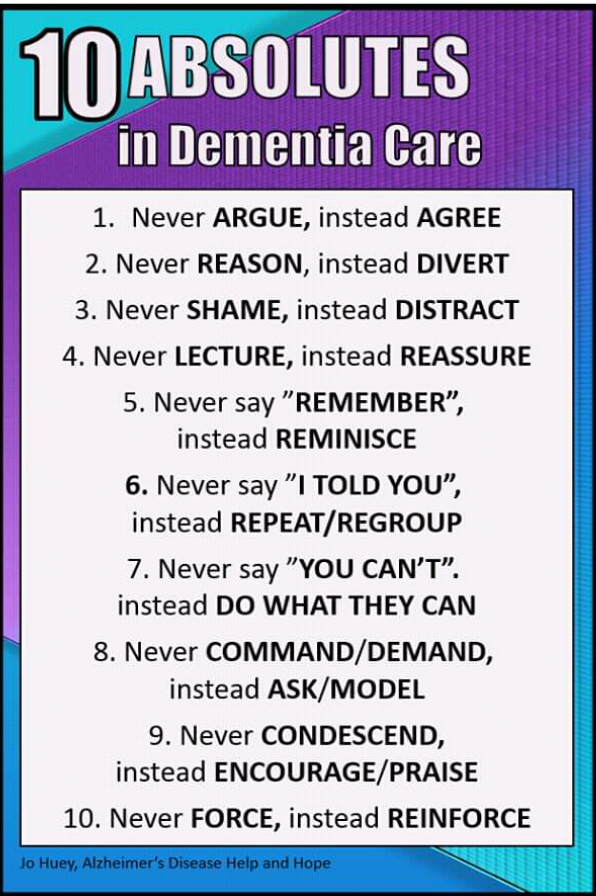
Moms doctor prescribed medication for her anger. She was not happy about it. She told me she wasn’t going to take medication for her “so called mood problems “. I waited a week and told her the new medication was for her blood pressure and that worked well. I think there are a few approaches to dealing with a difficult person with dementia. 1. You do what needs to be done without consulting them or even telling them. Giving a person with dementia too much say in decisions causes them to be confused and overwhelmed. 2. Therapeutic fibs. If the truth is going to cause upset and anger it’s not worth it in my opinion. 3. Just let it go and agree with them. If it doesn’t matter, there is no point in pointing out they are wrong. If it is something important, then go with 1 or 2. Bottom line you NEVER try to reason with a person with dementia. It will only suck you into an argument. I have found as the caregiver I am always wrong. I have apologized for and taken blame for so many things I have never done. It’s hard to get your head into this way of thinking. In my opinion if she is being aggressive with your dad it is well past time to slip medication into her food. Her brain is not working properly and she need the medication! I attached a link about therapeutic fibs. I know nothing about the website, but I think is a good explanation. I also found the 10 absolutes of dementia care very helpful in the beginning.
https://www.darpelelderlaw.com/therapeutic-fibs-and-dementia-a-compassionate-approach-rooted-in-love
 0
0 -
One thing I would say is that to the extent you can get medical assistance, especially geriatric psychiatric or mental health support, I cannot recommend it enough. My mom was moved into MC and many things built up during her adjustment phase to where she was physical with staff. This was completely unacceptable and they tried to manage it as best they could. Things came to a head one day and she was completely out of control. The MC unit called 911 and mom was in our local Emergency Department on a psych hold for days before being transferred to a geriatric inpatient facility for more than a week. To say this was traumatizing for all of us (self, father, sibling, mom) is an understatement. I say this knowing that getting your LO to consent to psych care may add another challenge to an already challenging situation. I wish you luck and I'm sorry you're dealing with such a stressful situation.
0













Commonly Used Abbreviations
DH = Dear Husband
DW= Dear Wife, Darling Wife
LO = Loved One
ES = Early Stage
EO = Early Onset
FTD = Frontotemporal Dementia
VD = Vascular Dementia
MC = Memory Care
AL = Assisted Living
POA = Power of Attorney
Read more
Categories
- All Categories
- 634 Living With Alzheimer's or Dementia
- 350 I Am Living With Alzheimer's or Other Dementia
- 284 I Am Living With Younger Onset Alzheimer's
- 17.7K Supporting Someone Living with Dementia
- 5.7K I Am a Caregiver (General Topics)
- 8.7K Caring For a Spouse or Partner
- 2.9K Caring for a Parent
- 227 Caring Long Distance
- 180 Supporting Those Who Have Lost Someone
- 12 Discusiones en Español
- 1 Vivir con Alzheimer u Otra Demencia
- 1 Vivo con Alzheimer u Otra Demencia
- Vivo con Alzheimer de Inicio Más Joven
- 11 Prestación de Cuidado
- 2 Soy Cuidador (Temas Generales)
- 8 Cuidar de un Padre
- 23 ALZConnected Resources
- View Discussions For People Living with Dementia
- View Discussions for Caregivers
- Discusiones en Español
- Browse All Discussions
- Dementia Resources
- 8 Account Assistance
- 15 Help